
Your Relationship Is Making the Postpartum Depression Worse
PPD and relationship strain feed each other in a loop most treatment plans do not address. When one partner is depressed, the relationship takes the weight of it. When the relationship is strained, the depression has more to feed on. This post explains what that cycle looks like, why treating only one side does not work and what changes when both are addressed at the same time.
Postpartum depression (PPD) and relationship strain feed each other in a way that most couples never get told about. When one partner is depressed, the relationship takes the weight of it. When the relationship is strained, the depression has more to feed on. Couples get caught inside that cycle without understanding that both things are happening at once and that addressing only one of them leaves the other intact. What happens instead is that one of you gets individual support, the other gets told to be patient and the relationship absorbs everything while both of you wonder why nothing is getting better.
The most common thing I hear from the partner who does not have postpartum depression is some version of this:
"I keep trying. I don't know what else to do, and the harder I try, the more wrong I seem to get it."
From the partner who does: "I know you're trying. I just don't have anything left to receive it with."
Postpartum depression is a clinical condition, not a phase and it does not stay contained to the person it is diagnosed in.
Both of the above experiences are true. That is what makes this period so disorienting. The effort is there and so is the love, but the cycle you are inside is stronger than both of you. Nobody has named it yet and that is what this post is for.
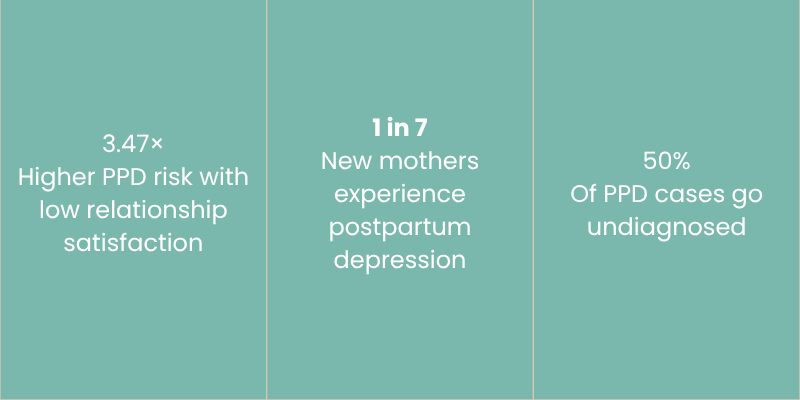
What I observe in my practice lines up precisely with what the research shows. Couples caught inside this cycle tend to look functional from the outside. They are co-managing a household, showing up for the baby, getting through the week. What has gone quiet is the reaching, the feeling of being known by the person across from you, the sense that you are in this together. That disconnection overtime is one of the strongest drivers of PPD severity. A 2025 meta-analysis published in the Journal of Affective Disorders found that low relationship satisfaction is the single strongest predictor of postpartum major depressive disorder, nearly tripling the risk.
A separate population-based study published in Frontiers in Psychology tracked couples through the postpartum period and found that depression symptoms were the primary driver of relationship decline. The depression was actively making the relationship harder to sustain while the relationship was making the depression harder to recover from.
The research points in both directions. Treatment plans rarely do.
What the Cycle Actually Looks Like
These are moments I have witnessed repeatedly in the therapy room. You may recognize your relationship in some of them.
When Depletion Gets Read as Rejection
From the therapy room:
"I know you think I'm shutting you out, but I literally do not have anything left."
"Then where am I supposed to go with any of this?"
Weeks of broken sleep and unspoken needs do something to a relationship that I watch happen slowly and invisibly, in the couples I sit with. What needed to be said is held back because you’re too tired and afraid of adding more weight to something that already felt impossible. They come out in the tone of a comment that was supposed to be about feeding bottles and diaper changes. It happens in the silence after a question neither of you answers, or a week of sleeping on opposite edges of the same bed without talking about why. Your partner feels that and pulls back, because reaching toward you lately has felt like something they keep getting wrong.
From where you are sitting, that pulling back reads as confirmation of what you were already afraid was true.
From where your partner is sitting, your silence reads the same way.
What I see underneath all of it is two people responding to the same fear, each one's silence becoming the other's evidence.
From the therapy room:
"I do bath. I wash bottles. I take the 5am shift. I do all of that."
"I haven't felt like your partner in months."
That is grief wearing the language of logistics. What I see in that exchange, across the couples I sit with, is two people who have stopped being able to reach each other because the shame of feeling unseen keeps arriving before anything else can.
When Trying to Help Becomes Evidence of Failure
From the therapy room:
"Every time you ask me what I need, I want to scream, because I do not even know."
"Then I guess I can never get it right."
This is the dynamic I see play out most in my practice. PPD makes it hard to name what you need or tolerate one more question when your nervous system is already at its limit. Your partner, trying not to add pressure starts holding their own needs back. After weeks of that, something comes out sideways. That can look like a sharp comment, withdrawal, a tone that says everything that has been holding back. You hear it and fold more inward. Your partner feels the closing off and pulls back more.
Both of you walk away confirming the fear you started with.
Your fear probably sounds something like; I am too much, I am broken, the relationship is suffering because of me. Your partner's fear sounds something like: she has stopped wanting me here, nothing I do lands.
Neither of you knows that what just happened was the depression driving the cycle, not evidence that either fear is true.
When the Pattern Starts to Feel Like Identity
Something shifts in the relationship when you stop talking to your partner and start talking about them. It sounds like: "She is always upset." "He cannot do anything without being told." "She takes everything personally." The moment you hear yourself saying that, you have moved from describing a moment to describing a person. The depression is doing something specific. It makes your partner's behavior look more permanent and more like a verdict on who they are rather than a reflection of what they are carrying. Every hard day starts to feel like character evidence rather than a hard day.
In the therapy room, that shift sounds like a couple who moved from "she was really struggling yesterday" to "she is always like this." By the time "always" enters the room, the depression and the relational strain have been running together long enough that one has started to feel like the other.
That is the signal I listen for.
A brief note on intimacy:Research published in Diagnostics in 2026 found that when mood symptoms and sexual difficulties are both present they compound each other over time. The silence in that area of the relationship carries its own weight and it does not lift without something naming it.
Why Treating Them Separately Misses the Point
When you try to address PPD and the relationship as two separate problems, something predictable happens. You get individual support, make real progress, and then come home to a dynamic that months of strain have already shaped. The distance is still there, the careful silence around everything that feels too big to say is still there, and none of that shifts because one person is doing better on their own. The cycle both of you have been living inside is not housed in one person. It lives between you. I have sat with couples where one partner had done months of genuine individual work and was meaningfully better, and still, the moment they walked through the front door, the cycle picked up exactly where it left off. The individual work mattered. What it could not reach was the relational pattern both of them had been living inside together.
The same holds in the other direction. When you address only the relationship without acknowledging that one of you is depressed, you can find yourselves working on communication skills inside a system where one person's nervous system does not yet have the capacity to use them.
The tools do not land and progress can keep stalling.
Neither of you understands why, because the problem was never “just communication”. it was one person's brain trying to function under the weight of depression while the relational environment kept adding to it.
A 2022 study published in Scientific Reports found that when partner support is present and felt, depressive symptoms are measurably lower. Your partner's response to your depression shapes how the depression moves. When the relational cycle runs undisturbed alongside individual work, it limits what that work can accomplish, because the environment you come home to every day is part of what the depression is feeding on. Individual therapy and couples work address different things. One works on what is happening inside a person. The other works on what is happening between two people.
Both matter and neither replaces the other.
"What I see in the therapy room is that PPD and relationship strain feed each other so completely that treating them as separate problems is where couples get stuck. You cannot fully address one without the other in the room when in a relationship."
— Evon Inyang, MA, LAMFT · ForwardUs Counseling

What Breaks the Cycle
In my experience, the shift rarely comes from one person changing their behavior. It comes from both of you being able to see the pattern you are inside, at the same time, in the same room and understanding that the pattern is the problem. Not each other.
"Most couples are having this conversation across a kitchen island, facing each other. What I do is move both of you to the same side. The problem sits across from you. Not your partner."
— Evon Inyang, MA, LAMFT --· ForwardUs Counseling
The moment I described earlier, when you say you have not felt like a partner in months, does not land as a complaint when the room is ready for it. It lands as an opening. Reaching that opening requires someone naming what is underneath the exchange first.
In the therapy room, that naming sounds like this: I stop the back-and-forth and say something like, "I don't think this fight is about groceries. I think postpartum depression has entered the relationship and now both of you are organizing yourselves around it. One of you is reaching harder because it feels like the connection is disappearing. The other is pulling back because it feels like nothing they do is landing." Then I turn to the partner who has been pulling back and ask directly: when your partner is crying or angry like this, what happens inside you right before you go quiet?
What I hear back sounds something like: "It feels like anything I say will be the wrong thing. She already looks disappointed before I even open my mouth. I tell myself to stay out of the way."
When the fear underneath the withdrawal gets named out loud, what shifts is the meaning both of you have been making of it.
"I thought you didn't care." The response, "No. I care so much that I panic."
That is the shift.
The depression does not disappear after that exchange and the hard work is not over, but the target changes.
You stop arguing about who is doing enough and whether either of you is even capable of getting this right. For that moment both of you can see what has actually been driving it; the PPD amplifying the sense of abandonment, the fear behind the withdrawal, each of you having read the other through pain instead of through what was actually there.
Once it gets named, it is a different room.
If You're Reading This at 2 A.M.
You are probably not here because everything is fine. Something has been off for a while and you are trying to understand it well enough to do something with it.
If you are the partner without PPD, the one who has been trying and hitting walls, the most important thing I can tell you is this: both of you are inside something bigger than either of you right now. The depression is using what your partner would normally bring to connection. Knowing that does not fix anything immediately, but it changes what the distance means and that changes what you reach for next.
If you are the person with PPD reading this and recognizing these patterns, the shame you are carrying is part of the condition. The depression arrived in your relationship without your permission. What it has done to the people you love is not a reflection of who you are. The fact that you are here, at whatever hour this is, trying to understand it, that is not a small thing.
What I have seen in couples who find their way through this is that they started by naming the pattern out loud. Sometimes just to each other, in the most perfectly, imperfectly words available. "I don't know what to do anymore but I don't want us to keep going like this."
That is enough to start.
The Pattern Has a Name. So Does the Next Step.
If what you have read here sounds like your relationship, that recognition is worth something. You do not have to have it figured out before you reach out. The Re|Pair™ Framework is built specifically for what you are carrying right now. The weight neither of you has been able to name yet.
ForwardUs Counseling offers virtual postpartum couples therapy across Minnesota. Learn more about working together or read 4 signs you might need postpartum couples therapy if you are still figuring out whether this fits.
Postpartum Depression and Relationship Problems: Your Questions Answered
-
Yes, and the relationship strain tends to make the depression worse at the same time. Postpartum depression changes how a person communicates and connects. When the relationship becomes strained in response, the isolation it creates is one of the strongest drivers of worsening PPD symptoms. Most couples are caught inside this cycle without realizing both things are happening at once and feeding each other.
-
Postpartum resentment is usually a signal that both people are exhausted and neither one feels seen. When one partner has PPD, the mental load, sleep deprivation, and emotional depletion fall unevenly, and the gap between what each person is carrying becomes the source of the resentment. It is not evidence that the relationship is broken. In most cases it is evidence that the system both people are living inside has become unsustainable, and nobody has named that yet.
-
Relationship unhappiness after a baby is extremely common and rarely means what people fear it means. The first year after birth is one of the highest-stress periods a couple can go through, and when postpartum depression is also present, it changes how both people communicate and connect. What feels like growing apart is often two people in survival mode who have lost the thread back to each other. That is something that can change.
-
The most important thing you can do is understand that what looks like distance or irritability is the depression, not your partner choosing to pull away. When the partner without PPD stops reading the symptoms personally and starts seeing the pattern, the dynamic between both people shifts. That shift is what creates room for recovery. Couples therapy can help both people get there faster than either one working on it alone.n
-
Yes, and when both the depression and the relationship are struggling at the same time, couples therapy is often more effective than individual therapy alone. Individual therapy changes one person. Couples therapy changes the system both people are living inside. You do not have to wait until the depression resolves to start. In many cases the couples work is part of what helps the depression move. When the relational cycle gets named, recovery tends to happen faster and with less lasting damage.
